
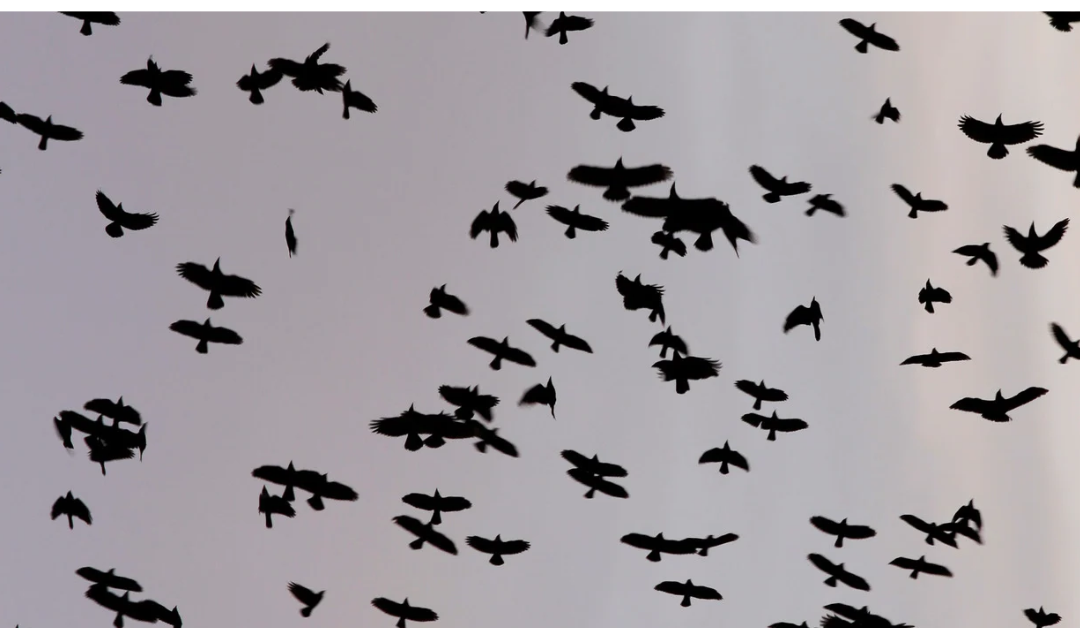
One chilly October night in 2006, I was walking back to my dorm at Indiana University Bloomington when I heard strange caws and clicking sounds coming from a series of large trees along a sidewalk. Curious where the sounds were coming from (and a bit spooked) I was astounded to see hundreds of crows gathered and settling in for the night. As a spooky soul and lover of crows, I could have stayed there all night listening to sounds of rustling feathers, and subtle chatter. This was my first encounter with a “murder of crows”.
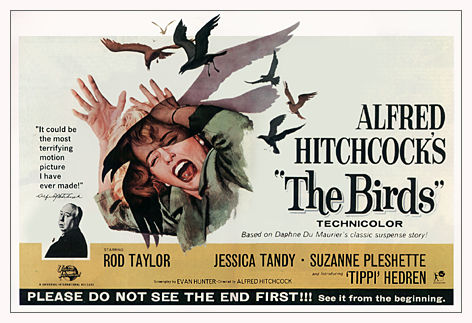
While this annual phenomenon might remind some of the unsettling scenes from the 1963 Alfred Hitchcock classic, The Birds; for birders, it’s a great opportunity to observe crows and their social behaviors. Every fall night around this time you can see masses of American Crows (Corvus brachyrhychos) in the trees, but why are they gathering, and why only at this time of the year?
 Though roosting occurs in smaller groups year-round, it begins in the fall when adults are free of their responsibilities of raising their young. Adult American Crows and their newly fledged young come together in the hundreds to roost in stands of trees at night. In the early afternoon, crows fly in from around the region to gather in raucous “staging” or “pre-roosting” areas. Some scientists think crows may use this time to share important details about where to find food, resources, and to warn others about danger, while others believe gathering provides safety in numbers – protection from predation like owls – or warmth, thermoregulation, in the colder months of the year. Their complex language and roosting behaviors have been studied by researchers like Bozeman’s Dr. John Marzluff, professor emeritus at the University of Washington and world-renowned corvid expert Dr. Kaeli Swift.
This gregarious roosting behavior is not unique to American Crows, but many other groups of birds as well. Red-winged Blackbirds, European Starlings, Tree Swallows, and Chimney Swifts roost in large numbers, especially around the Indreland Audubon Wetland Preserve.
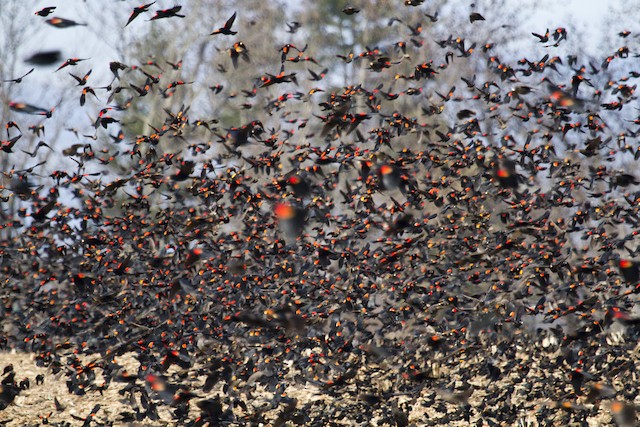
Photo: birdsoftheworld.org.
Interested in experiencing this phenomenon for yourself this spooky season? To find your local American crow roost, go outside before sunset, keep your eyes to the sky, and watch the mass “murder” settle in for the night. Be sure to document your finds on eBird or iNaturalist to help biologists understand these behaviors through citizen science data.
Fun Facts about American Crows
- The largest roost on record was recorded in Danville, Illinois with an astounding 325,000 birds.
- The largest gathering of crows on record took place near Fort Cobb, Oklahoma, where historical estimates placed a single winter roost at 2 million birds.
- Group names for animals like “a murder of crows” originated in the 1486 book, The Book of Saint Albans, but with the subtitle Treatyses on Hawkyng, Huntyng, and Cote Armours. The term, “a murder of crows” is 540 years old!*
- Correction from the printed SAS October newsletter: The phrase “a murder of crows” does not actually appear in The Book of Saint Albans, but famously lists, “an unkyndenes of rauenes” (an unkindness of ravens). The term “murder of crows” first appeared earlier in John Lydgate’s poem Hors, Shepe, & Ghoos, printed around 1470 and is ~556 years old. Image of original text below has been edited and enhanced for clarity. View original text here on page 44. Murther was an alternative spelling of murder. The spelling comes from older English roots (like Old English morthor). The word evolved from the Old English morðor (meaning a secret or unlawful killing). The modern spelling with a “d” became standard later under French and Latin influences, though the “th” spelling (murther) continued to be used into the 19th century.
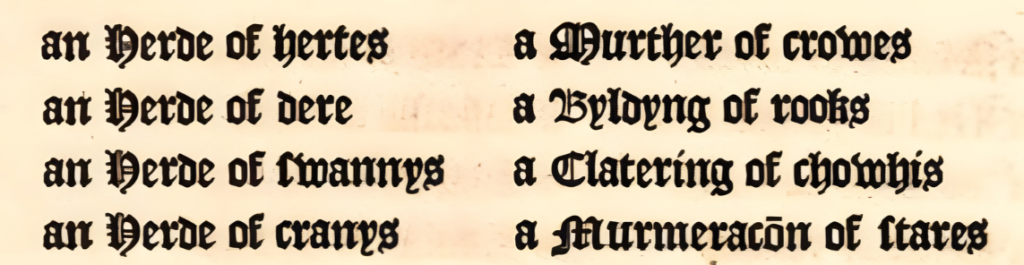
Exerpt from John Lydgate’s poem Hors, Shepe, & Ghoos.
- Roost sizes vary from less than 100 individuals to hundreds of thousands.
- In October 2024, Kevin Cox recorded an estimated ~509 crows at the Indreland Audubon Wetland Preserve via eBird!
Sources
- https://corvidresearch.blog/2017/12/08/15000-crows/
- https://thebatesstudent.com/28364/features/no-its-not-crow-pocalypse-the-biology-behind-campus-corvid-roosts/
- https://northernwoodlands.org/outside_story/article/crow-communication
- https://www.washington.edu/news/2017/12/05/rooftop-wiretap-aims-to-learn-what-crows-gossip-about-at-dusk/
- https://bookofsaintalbans.com
- https://babel.hathitrust.org/cgi/pt?id=wu.89098526486&view=1up&seq=44&skin=2021&q1=cr
- https://www.nwf.org/en/Magazines/National-Wildlife/2008/Bird-Watching