
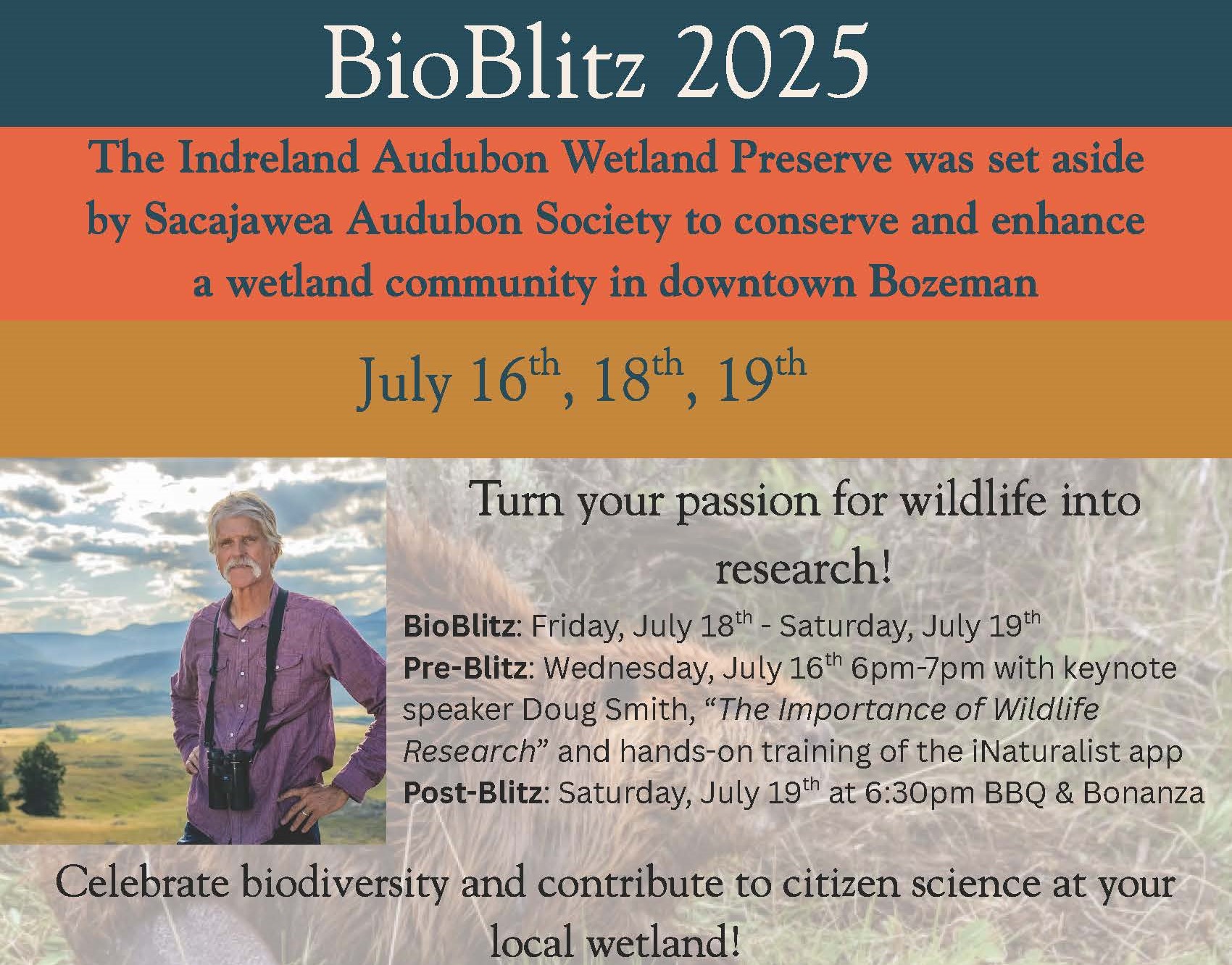
Welcome to the 4th annual BioBlitz at the Indreland Audubon Wetland Preserve!
Celebrate biodiversity and contribute to citizen science at your local wetland.
Wednesday July 16
Pre BioBlitz Bonanza
Featuring Keynote Speaker
Doug Smith
“The Importance of Wildlife Research”
Bozeman Public Library Community Room
626 E Main St, Bozeman
Turn your passion for wildlife into research and join us for the Pre Blitz Bonanza on July 16 at the Bozeman Public Library and the Main BioBlitzing Event at the Indreland Wetland, July 18 & 19.
Participant sign-up form: https://secure.lglforms.com/form_engine/s/udz3EoZzf4gqAZy7Wph55w
The Indreland Audubon Wetland Preserve is an urban wetland restoration site, a subsidiary of the Sacajawea Audubon Society. As the site is being protected, enhanced and restored, we will use the annual BioBlitz along with other survey efforts to get yearly snapshots of which species are living in and benefitting from this wetland.
A BioBlitz is an event in which community members find and identify as many species as possible in a specific area over a short period of time. Participants do not need any prior experience! Each session will have experts who will focus on educating the groups on surveying species. All observations will be uploaded to iNaturalist where they can be collected, reviewed, and compared with previous years.
Turn your passion for wildlife into research and join us for the Pre Blitz Bonanza on July 16 at the Bozeman Public Library and the Main BioBlitzing Event at the Indreland Wetland, July 18 & 19.
The BioBlitz starts on Wednesday, July 16th from 6:00PM to 7:30PM, with the Pre-Blitz Bonanza at the Bozeman Public Library. Join us with featured Keynote Speaker Doug Smith, “The Importance of Wildlife Research”. After the presentation, grow your understanding and skill level with hands-on training of the iNaturalist app. We’ll provide some hors d’oeuvres, you provide your enthusiasm!
Doug Smith served as a wildlife biologist at Yellowstone National Park for nearly three decades and studied everything from beavers to birds. Most importantly, he led the Yellowstone Wolf Project, which reintroduced gray wolves to the park. He’s written numerous scientific publications
During our BioBlitz weekend you can sign up for as many time blocks as you would like. Each survey lasts approximately 2 hours. Our 24 hour survey will take place Friday, July 18 at starting at 6:30PM through Saturday, July 19 ending at 7:00PM
Mammals
Look for mammal signs including tracks, scat, and beaver/muskrat constructions. Set up a camera to catch overnight mammal activity. Try to catch crepuscular mammals as they become active closer to sunset.
Bats and Nocturnal Birds
Listen and watch for bats and nocturnal birds like owls and nighthawks. We will set up recording stations to be analyzed later, but we will use an app to start to identify bat calls while we’re in the field.
Birds
Search the wetland for bird species using scopes, binoculars (we have several to lend out if needed), field guides, and ID apps like Merlin.
Plants
Walk around different parts of the wetland including much of the South Parcel and the edge of the Alder Swamp to identify plant species and learn about plant ecology at our site from your team leaders. These groups may go off the trail into wet and uneven terrain.
Terrestrial Invertebrates
Walk around the wetland and identify insects and other invertebrates that live on land using iNaturalist, field guides, and magnifying lenses and learn about different insect families. Participants may go off the trail into wet and uneven terrain.
Insect Black lighting
Setup a blacklight and a sheet to attract nocturnal insects. Capture, identify, and photograph insects before letting them go. We will provide hand lenses as well as some field guides and ID information. This group will stay in one location on a trail or road.
Aquatic Macroinvertebrates
Sample and identify aquatic macroinvertebrates while learning about the life and ecological role of these important critters, which include insect larvae, worms, snails, and crustaceans, and what we can learn from them about the state of our waterways. Participants who want to be more hands-on may want tall boots or waders. Others may stay on dry land during sampling and wait until the invertebrates are collected and then join the group in learning how to identify them.
To sign-up as a participant, follow the link below:
- Participant sign-up form: https://secure.lglforms.com/form_engine/s/udz3EoZzf4gqAZy7Wph55w